
Translation note: This English version follows the structure, data, figures, and references of the corresponding Chinese post. It was translated and synchronized on 2026-08-03.
ChatGPT Android Product Analysis Report
Author: AndyCao
Affiliation: Department of Data and Systems Engineering, The University of Hong Kong
Contact: Please use the public contact links on this site.
Report date: January 15, 2025
Abstract
This report provides an in-depth analysis of the ChatGPT Android application developed by OpenAI. It evaluates the app’s functionality in mobile contexts, user needs, and competitiveness in the market.
Since ChatGPT was released, generative AI has attracted extensive attention around the world. Its Android application further meets users’ need for immediate assistance during fragmented periods of time. Through hands-on testing, data collection, and competitor comparison, this report systematically examines the core functions, user personas, usage scenarios, strengths, weaknesses, and market performance of ChatGPT on Android. The results show that the app attracts a large user base through strong content generation, cross-platform continuity, and multimodal input.
However, the mobile application still faces challenges such as unstable network connections, limited information accuracy, and incomplete functional details. The user-needs analysis indicates strong demand for more accurate and reliable information, a better user experience, and broader functionality.
This study also presents a SWOT analysis and proposes improvement recommendations and future development strategies based on the identified issues. The recommendations cover performance optimization, functional enhancement, user-experience refinement, monetization, and ecosystem development. To preserve ChatGPT’s competitive advantage in the mobile market, the report argues that OpenAI should improve the accuracy and reliability of information, pay closer attention to interaction details, and provide more specialized services for vertical domains.
Keywords: ChatGPT, generative AI, mobile application, user-needs analysis, competitor analysis, product optimization
1. Background Analysis
Since OpenAI released ChatGPT (Chat Generative Pre-trained Transformer) on November 30, 2022, artificial intelligence has become a global focus of attention. According to a UBS report, ChatGPT surpassed 100 million users only two months after launch, making it the fastest-growing consumer internet application in history at that time (Bhaimiya, 2023).
During the rapid development of generative AI over the following two years, ChatGPT’s models evolved from the original GPT-3.5 to GPT-o3. Their strong conversational and information-processing capabilities have had a far-reaching impact across many fields. ChatGPT has become a phenomenon-level AI application and has brought unprecedented changes to human-computer interaction. As generative-AI use cases have expanded from content generation to natural-language understanding, ChatGPT has gradually become a preferred tool for obtaining information and improving efficiency.
At the same time, the spread of smartphones and the growth of information needs have created several problems for people using AI tools on mobile devices:
- Information overload: Faced with an enormous amount of information, users may struggle to find what they need quickly, while the efficiency of traditional search tools is increasingly limited.
- Efficiency demands: In everyday life and work, users need to generate high-quality text, organize complex information, or translate languages quickly, but mobile workflows do not always support these tasks efficiently.
- Fragmented time: Users want to complete more tasks in short periods of free time, but existing tools can involve too many steps and respond too slowly.
To address these pain points, OpenAI released the ChatGPT iOS and Android versions on May 18 and July 25, 2023, respectively. Users could then access an AI assistant from anywhere. The mobile applications provide powerful text generation as well as multitask support and conversational assistance, making them a pocket assistant that combines a chatbot, information-retrieval tool, and conversation partner.
How to further optimize ChatGPT for efficient use in fragmented mobile contexts remains an important question. This report therefore examines the Android app’s features, user needs, and competitive environment, with the aim of informing product optimization and promotion.
1.1 Product Overview
ChatGPT Android is a chatbot based on OpenAI’s generative-AI technology. It is designed to provide convenient and efficient interaction. As a mobile application for the ChatGPT model, it brings generative AI into everyday life and work, helping users solve problems, create content, and improve efficiency at any time.
Its core functions include:
- Text generation: ChatGPT can quickly generate high-quality text from user input, including copywriting and emails.
- Multimodal input: It supports voice, image, video, and document input. Users can ask questions by voice or share a camera view, creating a broad range of interaction options.
- Context understanding: Its context-handling capability allows it to remember the logic of a conversation and provide a more natural and coherent dialogue experience.
- Multilingual support: Users can communicate in multiple languages and receive answers in the relevant language, which supports translation and cross-language communication.
- Personalization: Users can review previous conversations through chat history. The memory feature can retain relevant information about a user and provide more personalized responses in later conversations.
1.2 Analysis Goals and Scope
As generative AI has developed rapidly, ChatGPT has become a leading AI product, and its Android app meets users’ immediate needs in fragmented contexts. This report evaluates the Android app’s functionality, user needs, and competitive environment in order to identify its advantages and limitations in mobile contexts and provide recommendations for product optimization and promotion.
The report focuses on four areas:
- Product-function analysis: Evaluate the Android app’s core functions and user experience.
- User-needs analysis: Explore the main usage scenarios and pain points of its user groups.
- Competitive-environment analysis: Compare the mobile performance of major AI chatbots and identify ChatGPT’s differentiated advantages.
- Optimization recommendations: Propose improvements based on existing issues to strengthen the product’s competitiveness.
2. Methods and Environment
2.1 Test Environment
- App version: ChatGPT for Android 1.2024.352
- Device: OnePlus Ace 2
- Android version: 14
- Test period: December 2024
- Evaluation purpose: Understand ChatGPT’s product functions, features, and performance
2.2 Analysis Methods
This report uses three methods to analyze ChatGPT Android systematically:
Hands-on testing
I used the Android app directly and evaluated its core functions, including text generation, voice input, conversational context, and history access. I also examined its performance in scenarios such as learning, office work, and creative writing. The main dimensions were:
- Functional completeness: Whether the core features work as expected and meet basic user needs.
- User experience: Whether the interface is friendly and operations are convenient.
- Performance: Response speed, stability, and other key indicators.
Data collection
Public market data and user feedback about ChatGPT Android were collected from several sources:
- Market data: Discussions, download estimates, monthly unique devices, and real-time rankings from Google Play, Reddit, and other platforms.
- User reviews: Google Play reviews used to summarize positive and negative opinions about product functions and experience.
- Industry reports: Reports from Statista, data.ai, and other third parties used to understand the wider mobile generative-AI market.
Competitor comparison
Google Gemini and Doubao AI Assistant were selected as the two primary competitors. The three products were compared across:
- Core functions: Text-generation quality, voice-input accuracy, and conversational context understanding.
- User experience: Interface design, ease of operation, and functional integration.
- Market performance: Downloads, active users, and user ratings.
Together, these methods present ChatGPT Android’s functional performance, fit with user needs, and differentiated advantages, while providing data and direction for optimization and promotion.
3. Product Overview
3.1 Product Overview and Positioning
3.1.1 Product Overview
ChatGPT Android is an intelligent assistant developed by OpenAI and built on generative-AI technology. Based on large language models such as GPT-4o, it uses natural-language interaction to provide efficient and accurate assistance.
3.1.2 Product Positioning
Functional positioning
ChatGPT is more than a chatbot. It is a “pocket assistant” with several complementary roles:
- Knowledge engine: Quickly search for information and solve complex problems.
- Efficiency tool: Generate, translate, and summarize content to improve work and learning efficiency.
- Creative partner: Provide ideas and concrete suggestions for creative writing and content planning.
- Emotional companion: Offer conversational interaction that can help users ease loneliness or engage in casual conversation.
User-group positioning
Although ChatGPT serves a broad audience, its users can be roughly divided into two groups according to their scenarios and needs:
- Individual users: Use it for learning, such as answering questions and generating documents; entertainment, such as conversational companionship; and everyday assistance, such as itinerary planning and consultation.
- Enterprise users: Use it for customer support, content marketing, and internal-process optimization, such as document organization and automated generation.
By covering diverse functions and scenarios, ChatGPT Android positions itself as an all-purpose intelligent assistant, especially suited to users who need to solve problems quickly or make productive use of fragmented time.
3.2 User-Needs Analysis
I used Python’s praw library, with assistance from ChatGPT, to crawl discussions from three Reddit questions about how people use ChatGPT (Reddit, 2023a; Reddit, 2023b; Reddit, 2024).
The resulting CSV contained 1,116 records with timestamps, users, and comment text. The data was first cleaned and divided into 207 comments containing fewer than eight words and 909 comments containing more than eight words.
The 207 lower-quality comments were combined into text files and analyzed with Google’s Gemini 2.0 Flash Experimental model to infer possible use cases. For the 909 longer comments, the Doubao-pro-4k, Doubao-pro-32k, and Doubao-pro-128k models from Volcano Engine were used to classify each comment into five fields: use case, persona, strengths, weaknesses, and needs.
Each of the five fields was then extracted into its own set of text files and uploaded to Google’s Gemini 2.0 Flash Experimental model for individual label analysis. The results were finally counted and visualized.
The workflow is shown below:
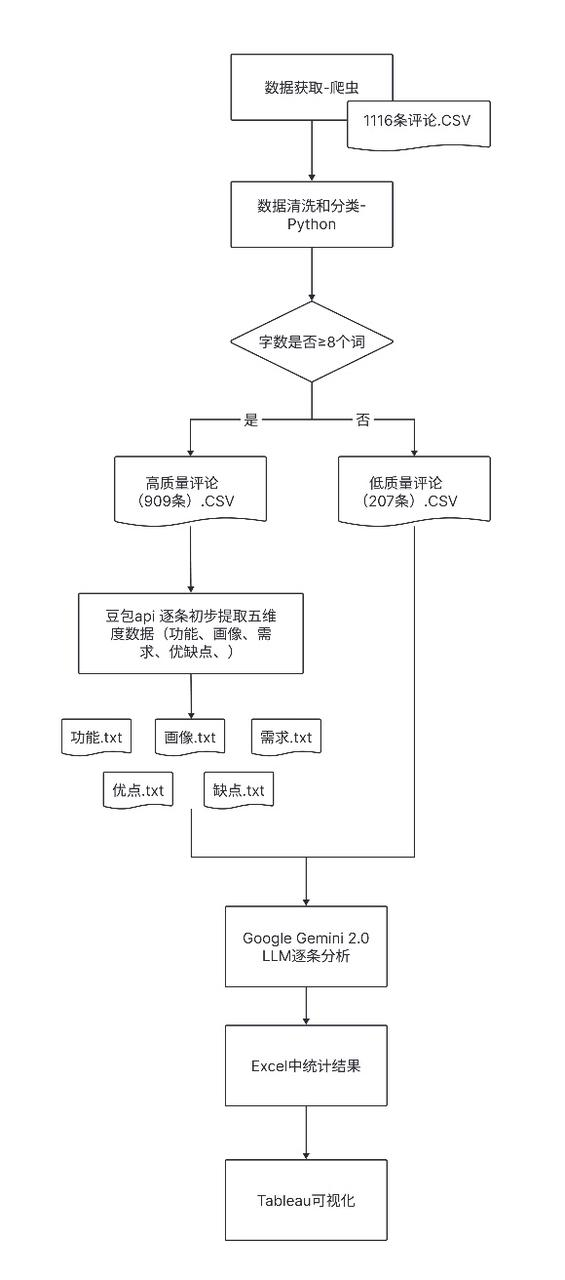
Data-analysis workflow
Gemini 2.0 Flash Experimental was selected because Chatbot Arena, a platform that ranks large models through blind testing, placed it fourth at the time. In hands-on use it also showed good response speed, making it suitable for the final analysis.
The raw crawl data was not sent directly to a large model. That approach was tested, but even Gemini 2.0 Flash Experimental returned very limited results and ignored valuable details in the comments. The data was therefore analyzed comment by comment first, then passed through a second model-analysis stage, and finally summarized in Excel. This produced a more reliable classification.
3.2.1 ChatGPT Use Cases
The comments were classified into eleven broad types of ChatGPT use:
Coding and development assistance
This category covers software development, programming, and script-writing activities supported by ChatGPT. It includes code writing, debugging, explanation, generation, optimization, programming education, API usage, and automation scripts.
Learning and education
This category covers learning, knowledge acquisition, and education supported by ChatGPT. It includes coursework, homework help, concept explanation, exam preparation, learning plans, language learning, and knowledge expansion.
Content creation
This category covers generating original content in forms such as text and images. It includes blog posts, novels and stories, poetry, scripts, lyrics, marketing copy, social-media posts, and website content.
Work and productivity
This category covers everyday work and productivity support, including drafting or polishing email, document processing, meeting minutes, report generation, data analysis, spreadsheet work, project management, planning, business-case research, and communication support.
Information retrieval and research
This category covers obtaining information, conducting research, and exploring knowledge. It includes quick searches, fact checking, data lookup, literature search, concept explanation, and domain-specific knowledge.
Entertainment and leisure
This category covers role-play, game assistance including D&D, creative writing such as humorous stories, riddles and games, music and film recommendations, casual conversation, and using AI to pass the time.
Emotional and psychological support
This category covers emotional support, psychological comfort, self-reflection, emotion management, companionship, encouragement, and motivation.
Daily assistance and life management
This category covers meal plans, health management, travel planning, scheduling, shopping lists, and household management.
Translation and language processing
This category covers translation, language learning, style polishing, and grammar checking.
Others
This fallback category covers uses that cannot be clearly assigned to the other categories, including unusual or mixed use cases and uses that are unrelated to the main categories.
Unknown or unclear
This fallback category covers comments that do not reveal what the user is doing with ChatGPT. Compared with “Others,” these comments contain even less information, often because they are too short, vague, or only express a question or opinion without describing a use case.
Data and analysis
The full-count method counted every use mentioned in each of the 1,116 comments. The resulting distribution was:
| Use-case category (full count) | Count | Share |
|---|---|---|
| Coding and development assistance | 252 | 12.81% |
| Learning and education | 208 | 10.57% |
| Content creation | 143 | 7.27% |
| Work and productivity | 415 | 21.10% |
| Information retrieval and research | 190 | 9.66% |
| Entertainment and leisure | 124 | 6.30% |
| Emotional and psychological support | 33 | 1.68% |
| Daily assistance and life management | 143 | 7.27% |
| Translation and language processing | 34 | 1.73% |
| Others | 226 | 11.49% |
| Unknown or unclear | 199 | 10.12% |
| Total | 1,967 | 100.00% |
After removing the “Others” and “Unknown or unclear” categories, the distribution was:
| Use-case category (full count) | Count | Share |
|---|---|---|
| Coding and development assistance | 252 | 16.34% |
| Learning and education | 208 | 13.49% |
| Content creation | 143 | 9.27% |
| Work and productivity | 415 | 26.91% |
| Information retrieval and research | 190 | 12.32% |
| Entertainment and leisure | 124 | 8.04% |
| Emotional and psychological support | 33 | 2.14% |
| Daily assistance and life management | 143 | 9.27% |
| Translation and language processing | 34 | 2.20% |
| Total | 1,542 | 100.00% |
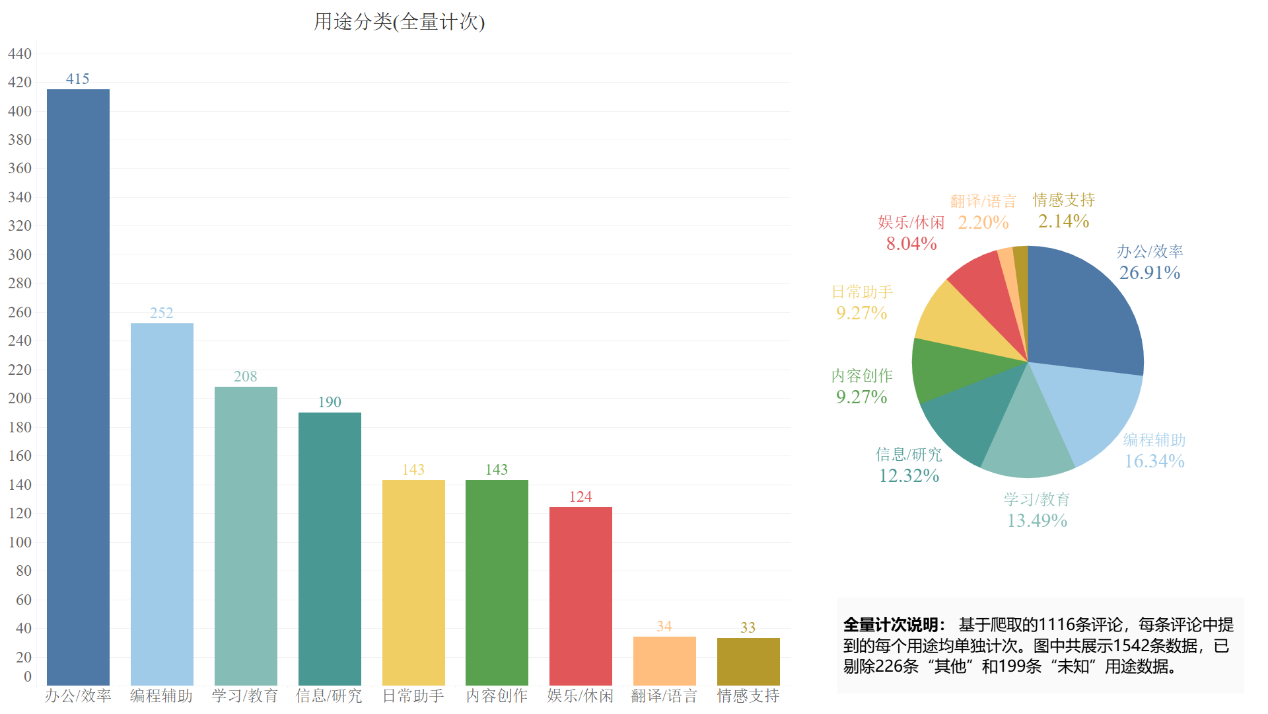
Distribution of ChatGPT use cases
Primary findings
- Work and productivity is the core use case (26.91%): Among clear use cases, work and productivity are the leading reasons people use ChatGPT, well above the other categories. This highlights its value as a workplace and productivity tool.
- Coding and development and learning and education are both important (16.34% and 13.49%): Technical development and education needs are highly visible and close in share, showing ChatGPT’s appeal in both technical and knowledge domains.
- Information retrieval and research remain significant (12.32%): Information acquisition and research are important motivations, demonstrating the value users place on ChatGPT as an information source.
- Content creation and daily assistance are at the same level (9.27% each): The two categories have similar shares, showing demand for both creative support and life management.
Secondary findings
- Entertainment and leisure is stable (8.04%): Even after unclear uses are removed, a meaningful group uses ChatGPT for entertainment.
- Emotional support and translation remain smaller categories (2.14% and 2.20%): This may indicate that users prefer specialized tools or human services for these needs, or that ChatGPT has not yet been adopted as widely in these areas.
3.2.2 User Personas
The 909 higher-quality comments were used to classify users into eight broad personas:
- Students: University students, high-school students, graduate students, and medical students.
- Programmers and developers: Front-end, back-end, and full-stack developers, game developers, software engineers, IT consultants, network engineers, data analysts, and DevOps practitioners.
- Professionals: Teachers, doctors, lawyers, sales and marketing staff, human-resources professionals, managers, analysts, and administrators.
- Content creators: Writers, screenwriters, bloggers, journalists, YouTubers, video creators, copywriters, and game creators.
- Educators and researchers: Researchers, doctoral students, graduate students, teachers, tutors, and university administrators.
- General users: People using ChatGPT or other AI tools without a clear professional, educational, or interest-based identity. Their scenarios include information lookup, entertainment, advice, simple problem solving, and language learning.
- Other: Users who do not fit the main classifications or have complex, mixed, or unusual identities, such as freelancers, self-employed people, fitness enthusiasts, and food enthusiasts.
- Unclear: Users whose identity or background information is insufficient.
Because the 207 low-quality comments contained too little information, the later persona and strengths-and-weaknesses analysis used only the 909 higher-quality comments. Each comment contributed one unit of weight.
| User persona | Count | Share |
|---|---|---|
| Programmers and developers | 153 | 16.83% |
| Educators and researchers | 30 | 3.30% |
| Content creators | 73 | 8.03% |
| Students | 72 | 7.92% |
| Professionals | 85 | 9.35% |
| General users | 135 | 14.85% |
| Other | 260 | 28.60% |
| Unclear | 101 | 11.11% |
| Total | 909 | 100.00% |
After removing unclear identities and merging “Other” with general users, the distribution became:
| User persona | Count | Share |
|---|---|---|
| Programmers and developers | 153 | 18.94% |
| Educators and researchers | 30 | 3.71% |
| Content creators | 73 | 9.03% |
| Students | 72 | 8.91% |
| Professionals | 85 | 10.52% |
| General users | 395 | 48.89% |
| Total | 808 | 100.00% |
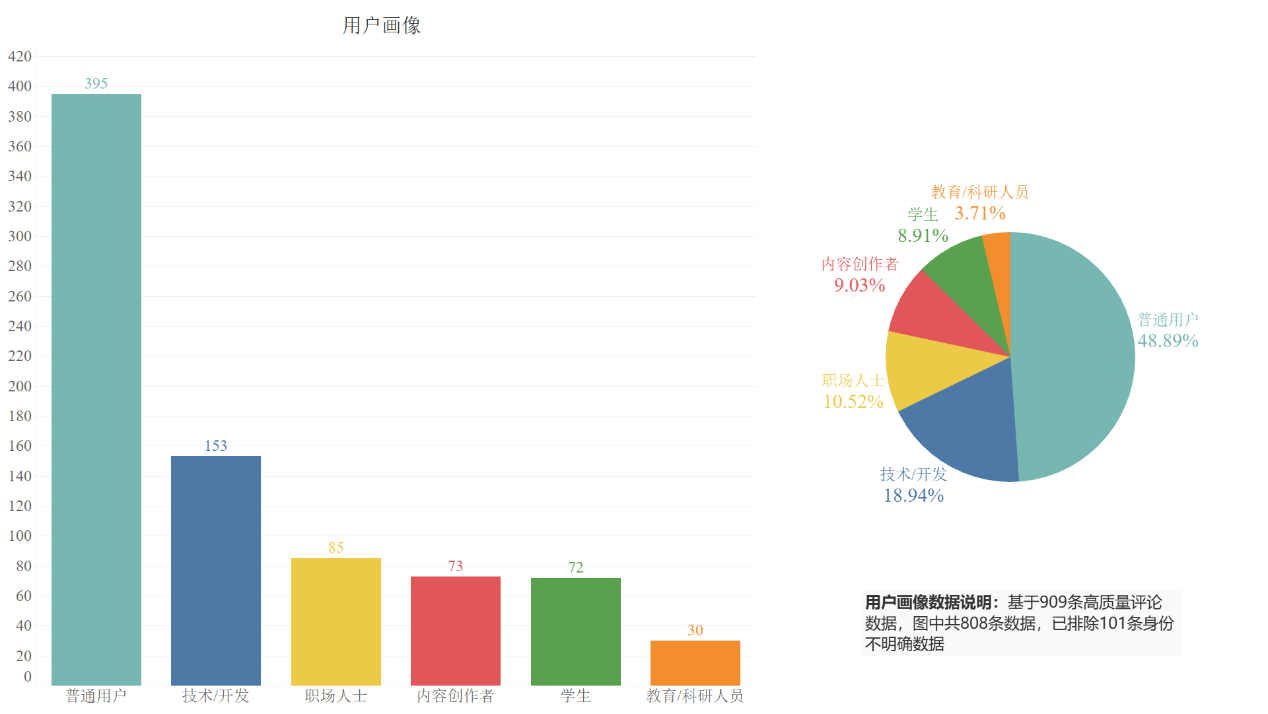
User-persona demographics
Primary findings
- General users are the clear majority (48.89%): Nearly half of the users fall into the general-user category. This indicates that ChatGPT’s ease of use and versatility attract many non-specialist users, and that a substantial share may currently use ChatGPT as an alternative to a search engine.
- Developers are an important professional group (18.94%): Developers are the second-largest group. This aligns with coding assistance being a major use case and reinforces ChatGPT’s value in technical work.
- Professionals form a significant group (10.52%): Their share exceeds 10%, corresponding to the finding that work and productivity are major use cases.
Secondary findings
- Content creators and students are similar in size (9.03% and 8.91%): Both groups remain important, showing the appeal of ChatGPT for content generation and education.
- Educators and researchers are a smaller group (3.71%): This may be because they prefer other specialized tools or because ChatGPT’s features do not fully meet their needs. The Reddit source itself also introduces systematic sample bias.
3.2.3 Strengths and Weaknesses
Strengths
Full-count analysis of explicitly mentioned strengths produced 740 valid records after removing 385 blank records. The strengths fell into eight categories:
- Creativity and inspiration: ChatGPT is widely praised as a creative tool that expands imagination, inspires writing, and provides a starting point for new ideas.
- Efficient information retrieval and question answering: Users say it provides information and answers quickly, saves time compared with search engines, avoids advertising noise, and often gives relatively precise results.
- Versatile use cases: Users apply ChatGPT to writing, programming, education, business, entertainment, and everyday life.
- Strong text generation: It can draft emails, reports, papers, stories, poems, and code, and adjust the output to specific requirements.
- Learning assistance and knowledge understanding: It helps explain complex concepts and legal terms, provide course outlines, and teach patiently.
- Programming assistance: It can generate code, provide debugging suggestions, teach programming languages and frameworks, and accelerate development.
- Good user experience: Users generally find ChatGPT convenient, friendly, responsive, and capable of providing help in several formats.
- Time savings: Many users say ChatGPT saves significant time and improves their productivity.
| Strength (full count) | Count | Share |
|---|---|---|
| Programming assistance | 72 | 9.73% |
| Versatile use cases | 118 | 15.95% |
| Learning assistance and knowledge understanding | 91 | 12.30% |
| Efficient information retrieval and question answering | 97 | 13.11% |
| Time savings | 39 | 5.27% |
| Creativity and inspiration | 35 | 4.73% |
| Strong text generation | 81 | 10.95% |
| Good user experience | 207 | 27.97% |
| Total | 740 | 100.00% |
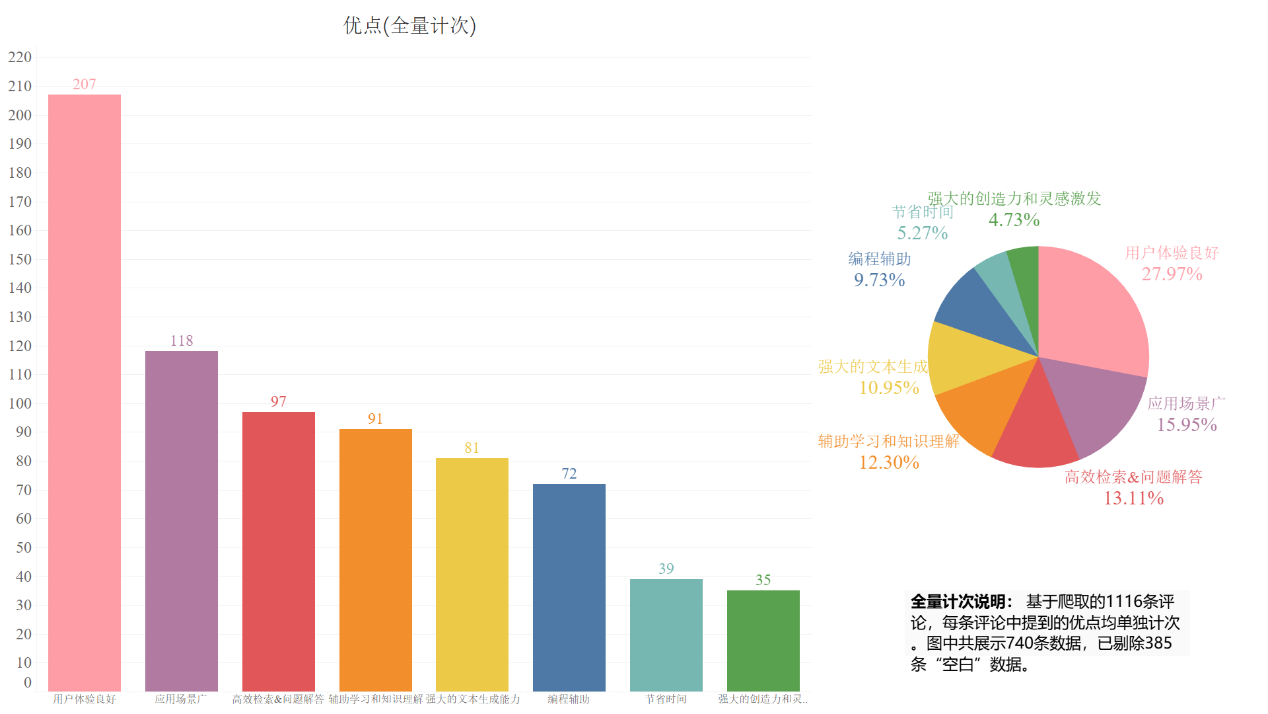
Summary of strengths and weaknesses analysis
Primary findings, ranked by share
- Good user experience is the largest strength (27.97%): More than a quarter of users considered the experience very good, which is important for adoption and retention.
- Versatile use cases are highly valued (15.95%): Users appreciate that ChatGPT can be used for writing, programming, education, business, entertainment, and everyday life. Generality is a clear advantage.
- Efficient information retrieval and question answering is a key advantage (13.11%): Users value quick answers, time savings, relatively precise results, and less advertising interference than in search engines.
- Learning assistance and knowledge understanding are important (12.30%): Users appreciate help with complex concepts, terminology, course outlines, and patient explanations.
- Strong text generation is widely recognized (10.95%): Users value its ability to write many kinds of text and adapt the output to their needs.
- Programming assistance receives meaningful recognition (9.73%): Users value code generation, debugging suggestions, and programming education, even if this ranks below overall experience.
Other points worth noting
- Time savings are a practical benefit (5.27%): This is a direct and attractive productivity gain.
- Creativity and inspiration have special value despite the smaller share (4.73%): ChatGPT is not only a tool but also helps people expand their thinking and find creative starting points, especially for content creators.
Weaknesses
The full-count analysis of explicitly mentioned weaknesses produced 191 valid records after removing 934 blank records. The weaknesses were grouped into twelve categories:
- Inaccurate information and hallucinations: ChatGPT sometimes provides inaccurate information, invents content, hallucinates, or expresses answers with excessive confidence.
- Prompt dependence: Its performance depends heavily on prompt quality, so users need enough knowledge and clear instructions to obtain good results.
- Knowledge cutoff and timeliness: At the time of the source analysis, the model’s knowledge cutoff was described as the end of 2021, so it could miss later developments and provide outdated or invalid links.
- Limitations in specific domains: It may be inaccurate in professional fields and struggle to explain complex books and specialist concepts.
- Repetitive and formulaic answers: Some users report that it gives similar answers to the same question and does not always follow instructions flexibly.
- Uneven code quality: Generated code may contain errors or vulnerabilities and require debugging.
- Risk of user dependence: Some users worry that excessive reliance on ChatGPT may weaken independent thinking and learning.
- Security concerns: Users worry about data security and possible copyright issues in generated content.
- Poor performance in some scenarios: Mathematics, translation, image generation, and summarization may not always meet expectations.
- Limited emotion and personality: ChatGPT has difficulty expressing human emotion and creating highly personalized content.
- Failure on specific questions: It may perform worse than search engines when asked for very specific facts, websites, or the latest information.
- Mobile-experience issues: Users mention inefficient interaction, editing glitches, inability to copy and paste code, and limits on the number of replies.
| Weakness (full count) | Count | Share |
|---|---|---|
| Security concerns | 8 | 4.19% |
| Poor performance in some scenarios | 17 | 8.90% |
| Uneven code quality | 22 | 11.52% |
| Repetitive and formulaic answers | 13 | 6.81% |
| Limited emotion and personality | 11 | 5.76% |
| Limitations in specific domains | 16 | 8.38% |
| Failure on specific questions | 7 | 3.66% |
| Inaccurate information and hallucinations | 50 | 26.18% |
| Prompt dependence | 7 | 3.66% |
| Risk of user dependence | 6 | 3.14% |
| Mobile-experience issues | 28 | 14.66% |
| Knowledge cutoff and timeliness | 6 | 3.14% |
| Total | 191 | 100.00% |
Primary findings, ranked by share
- Inaccuracy and hallucination are the most serious concern (26.18%): They directly affect reliability and trust, especially when the system presents a confident but incorrect answer.
- Mobile-experience issues are the second-largest pain point (14.66%): Although the overall experience is often praised, details such as editing, copying, and reply limits still need work.
- Uneven code quality is a major technical-user concern (11.52%): Generated code cannot be trusted without review and debugging.
- Poor performance in some scenarios is a practical limitation (8.90%): Generality does not guarantee strong performance on every task.
- Domain limitations restrict professional use (8.38%): The difficulty of explaining complex books and specialist knowledge limits depth.
- Repetitive answers reduce interaction quality (6.81%): This lowers flexibility and personalization.
- Limited emotion and personality constrain emotional interaction (5.76%): This also limits creative and companion use cases.
Other weaknesses worth noting
Security concerns (4.19%), failure on specific questions (3.66%), prompt dependence (3.66%), user dependence (3.14%), and knowledge-cutoff issues (3.14%) have smaller shares but still represent meaningful concerns. Security involves data and copyright, while prompt dependence raises the barrier to effective use.
Implications for product needs
- More accurate and reliable information: This is the most urgent need. Users want trustworthy answers and fewer hallucinations, because accuracy is central to trust.
- A better user experience: Users want smoother interaction, fewer editing errors, code copy-and-paste support, and fewer reply restrictions.
- Greater versatility: Users recognize the potential of ChatGPT across many domains and want more high-quality scenarios.
Important needs based on the middle-ranked strengths and weaknesses include:
- More professional and deeper support in specific domains.
- Higher-quality text generation with fewer repetitive or formulaic responses.
- More reliable programming assistance with fewer errors and vulnerabilities.
- Faster and more precise information retrieval and question answering.
The overall direction is therefore to improve model accuracy, refine interaction details, and provide more specialized help in vertical domains.
3.2.4 User Requirements
The following categories were identified from direct user requests and potential needs implied by the 909 higher-quality comments:
Code generation: code accuracy
- Description: Users want generated code to run correctly, follow sound logic, and contain fewer vulnerabilities.
- Examples from the source comments:
- “I hope ChatGPT can produce higher-quality code with fewer vulnerabilities.”
- “When writing code snippets, it should be more accurate and reliable, with fewer errors and invalid function calls.”
- “Provide more accurate code examples and solutions for specific problems.”
Code generation: efficient coding assistance
- Description: Users want efficiency gains during coding, such as better examples and clearer API guidance.
- Examples:
- “Provide more precise code examples and more complete library introductions.”
- “Give more precise and detailed guidance for JavaScript and CSS.”
- “Provide coding help more efficiently and accurately, with clear explanations.”
Tool optimization: personalized conversation
- Description: Users want more personalized interaction, including better role imitation and responses that fit their needs.
- Examples:
- “Imitate a character’s speaking style and tone more vividly and accurately, with more encouraging language.”
- “Imitate a role’s language style and characteristics more precisely, and provide more interesting riddles or interactions.”
- “Provide more precise and varied help in role-play and other specific scenarios.”
Tool optimization: functional improvement and expansion
- Description: Users want existing functions improved and new capabilities added.
- Examples:
- “Improve the product with more APIs, multimodality, and long-term memory; recommend recipes from photos, provide supportive companionship, and help plan projects and generate related content.”
- “Provide richer and better support for work and entertainment.”
- “Provide more personalized, flexible, and interesting assistance tools.”
Tool optimization: text-processing efficiency
- Description: Users want faster and more effective help with emails, copywriting, scripts, and other text tasks.
- Examples:
- “Provide more efficient and accurate script writing and communication generation to improve work efficiency.”
- “Polish work emails more efficiently and accurately, improving the professionalism of English expression.”
- “Assist online writing more efficiently, with more accurate content and higher writing efficiency.”
Tool optimization: stability and reliability
- Description: Users want stable operation, reliable answers, accurate results, and safer data handling.
- Examples:
- “A more stable and accurate language model may be needed.”
- “I hope ChatGPT can continue to provide stable assistance instead of being disabled.”
- “Save editing progress reliably and avoid data corruption or loss.”
Tool optimization: understanding user needs
- Description: Users want the provider to understand their tasks, habits, and contexts so that the service can be more targeted.
- Examples:
- “Understand users’ work and leisure tasks so it can explain the best way to use the tool.”
- “Understand where ChatGPT struggles with complex philosophical concepts and how people encounter those difficulties while learning.”
- “Understand how experienced technical users can make better use of ChatGPT.”
Content generation: creativity and uniqueness
- Description: Users want more original, creative, and stylistically diverse content.
- Examples:
- More vivid and accurate character imitation.
- More creative inspiration and writing assistance.
- More distinctive and motivating language styles.
Content generation: context and personalization
- Description: Generated content should fit a user’s context, goal, audience, and desired tone.
- Examples:
- “Provide richer and more appropriate wording for responding to aggressive emails.”
- “Rewrite emails more precisely and politely while preserving the original meaning.”
- “Understand customer needs and style more accurately when writing emails.”
Content generation: quality and accuracy
- Description: Users want generated content to be high quality, accurate, natural, and on topic.
- Examples:
- “Complete different types of correspondence efficiently and with high quality.”
- “Make copywriting more natural and closer to the user’s needs instead of overly commercial.”
- “Generate more precise content with fewer off-topic answers and mathematical errors.”
Information retrieval: deep explanation and understanding
- Description: Users want more than surface-level facts; they want explanations of underlying ideas and mechanisms.
- Examples:
- “Explain books more deeply and comprehensively, or interpret more types of books.”
- “Improve accuracy in professional knowledge and explain complex content better.”
- “Explain medical concepts and mechanisms more precisely and deeply.”
Information retrieval: problem solving and support
- Description: Users want effective advice, guidance, problem solving, and emotional support when facing difficult situations.
- Examples:
- “Provide more advice and information about dealing with Huntington’s disease.”
- “Continue to provide accurate and practical advice in emergencies.”
- “Offer better strategies and communication skills for arguments with a sister.”
Information retrieval: learning assistance
- Description: Users want learning plans, practice questions, knowledge explanations, and better study materials.
- Examples:
- “Provide more educational materials and cases to enrich lesson plans.”
- “Help organize learning materials, improve summaries, and generate more targeted flashcards.”
- “Provide more targeted study guidance and resources.”
Information retrieval: knowledge accuracy and reliability
- Description: Users want information to be accurate, reliable, current, and useful.
- Examples:
- “Analyze the value of stock investments more precisely and provide more detailed, targeted advice.”
- “Provide more accurate, detailed, and practical information about job hunting, gardening, and fishing.”
- “Provide more precise and richer support in more fields, including better medical-diagnosis reasoning.”
Unclear needs
- Description: Feedback that is too vague to classify or does not clearly express a potential need.
| Potential need | Count | Share |
|---|---|---|
| Code generation: code accuracy | 31 | 3.41% |
| Code generation: efficient coding assistance | 64 | 7.04% |
| Tool optimization: personalized conversation | 58 | 6.38% |
| Tool optimization: functional improvement and expansion | 119 | 13.09% |
| Tool optimization: text-processing efficiency | 29 | 3.19% |
| Tool optimization: stability and reliability | 57 | 6.27% |
| Tool optimization: understanding user needs | 57 | 6.27% |
| Content generation: creativity and uniqueness | 64 | 7.04% |
| Content generation: context and personalization | 93 | 10.23% |
| Content generation: quality and accuracy | 77 | 8.47% |
| Information retrieval: deep explanation and understanding | 41 | 4.51% |
| Information retrieval: problem solving and support | 8 | 0.88% |
| Information retrieval: learning assistance | 48 | 5.28% |
| Information retrieval: knowledge accuracy and reliability | 115 | 12.65% |
| Unclear needs | 48 | 5.28% |
| Total | 909 | 100.00% |
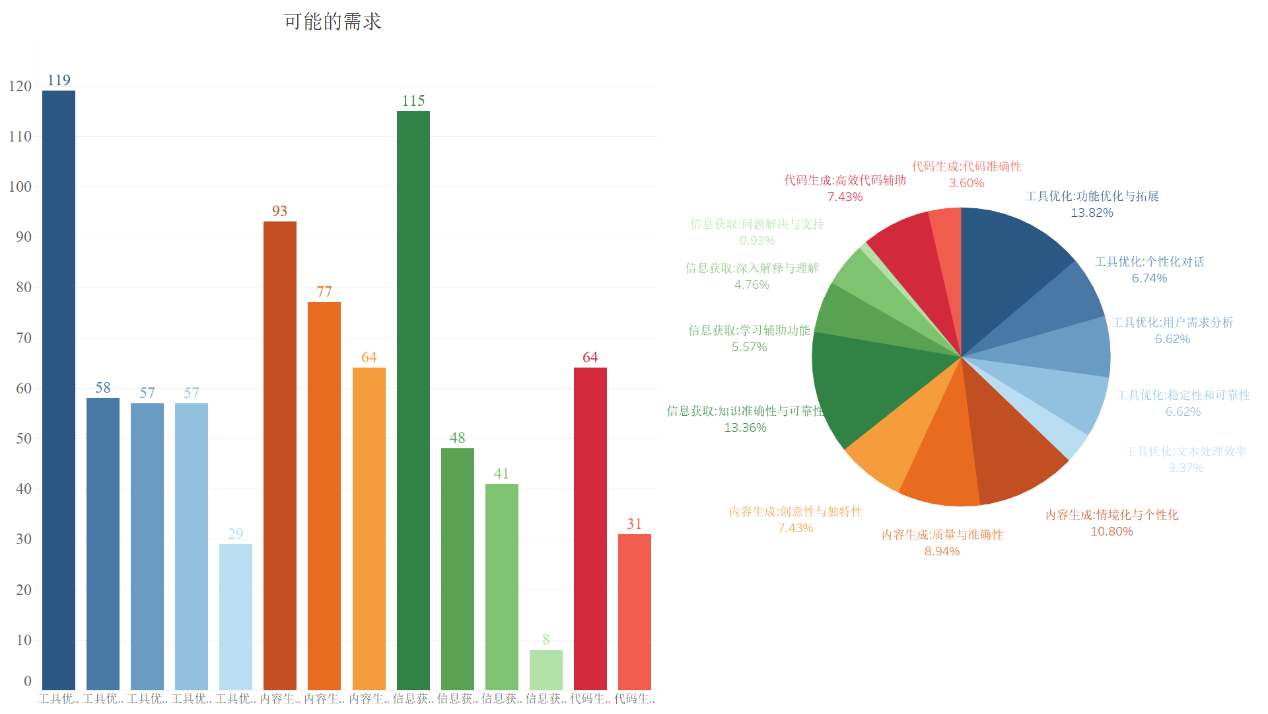
Latent user-needs analysis
Relationship to the strengths-and-weaknesses analysis
- Tool optimization (35.20%) corresponds to the need for better experience and versatility: Users want a more stable service, more personalized interaction, and more functions.
- Content generation (25.74%) corresponds to content-quality and creativity needs: Users expect higher-quality, more creative, and more personalized generated content.
- Information retrieval (23.32%) corresponds to accuracy and learning needs: Users want reliable information, stronger explanations, and better learning assistance.
- Code generation (10.45%) corresponds to programming-assistance needs: Users want more accurate and efficient coding support.
3.3 Market Status and Analysis
At the time of the source analysis, OpenAI’s ChatGPT business model had four main components:
- Subscription services: OpenAI offered paid plans such as ChatGPT Plus and ChatGPT Pro. Subscribers received benefits such as faster responses and priority access. Reports suggested that ChatGPT Pro, priced at $200 per month, was operating at a loss because usage exceeded expectations (Tencent News, 2025).
- API services: OpenAI provided APIs to enterprises and developers so they could integrate ChatGPT into their products and pay according to usage. This B2B model was considered a major potential source of future revenue (ESM China, n.d.).
- Advertising revenue: OpenAI was considering advertising in ChatGPT as a possible additional revenue source, although there was no confirmed plan at the time (The Times, n.d.).
- Customized services: OpenAI could provide customized model training and solutions for specific industries and enterprise needs (The Wall Street Journal, n.d.).
3.3.1 Monthly Downloads
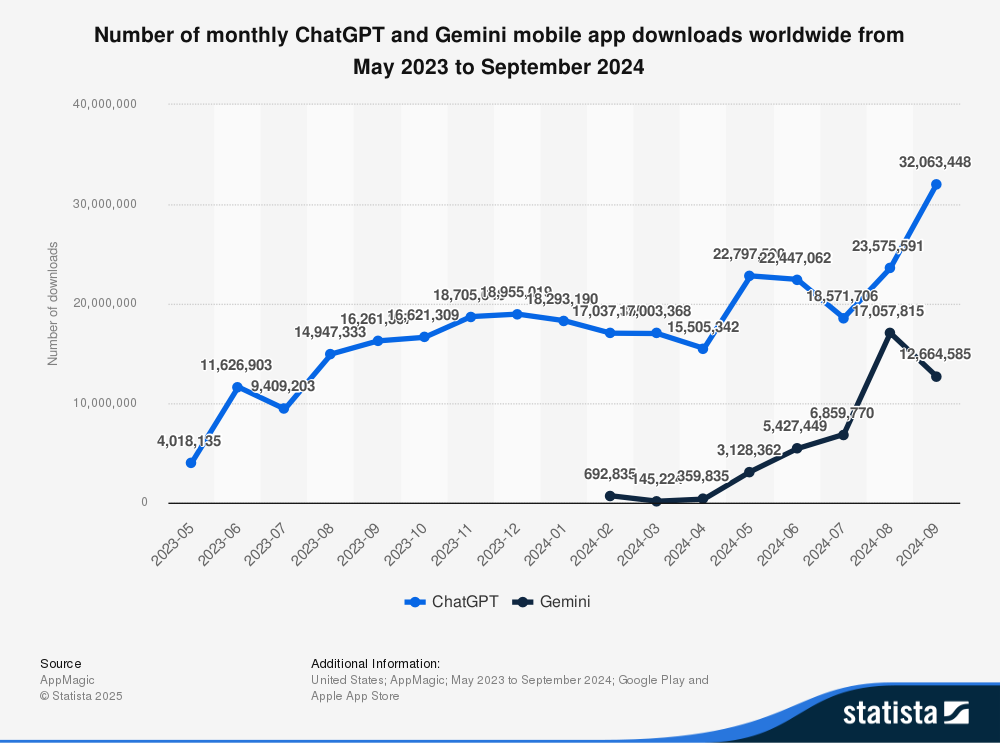
Monthly ChatGPT mobile-app download trend, May 2023–September 2024 (source: Statista)
Statista data shows a pattern of rapid growth, decline, and renewed growth from May 2023 to September 2024. Downloads peaked at approximately 18.7 million in November 2023, then declined before rising to approximately 23.57 million in September 2024. This indicates strong market appeal and a large user base (Statista, n.d.).
3.3.2 Real-time Ranking
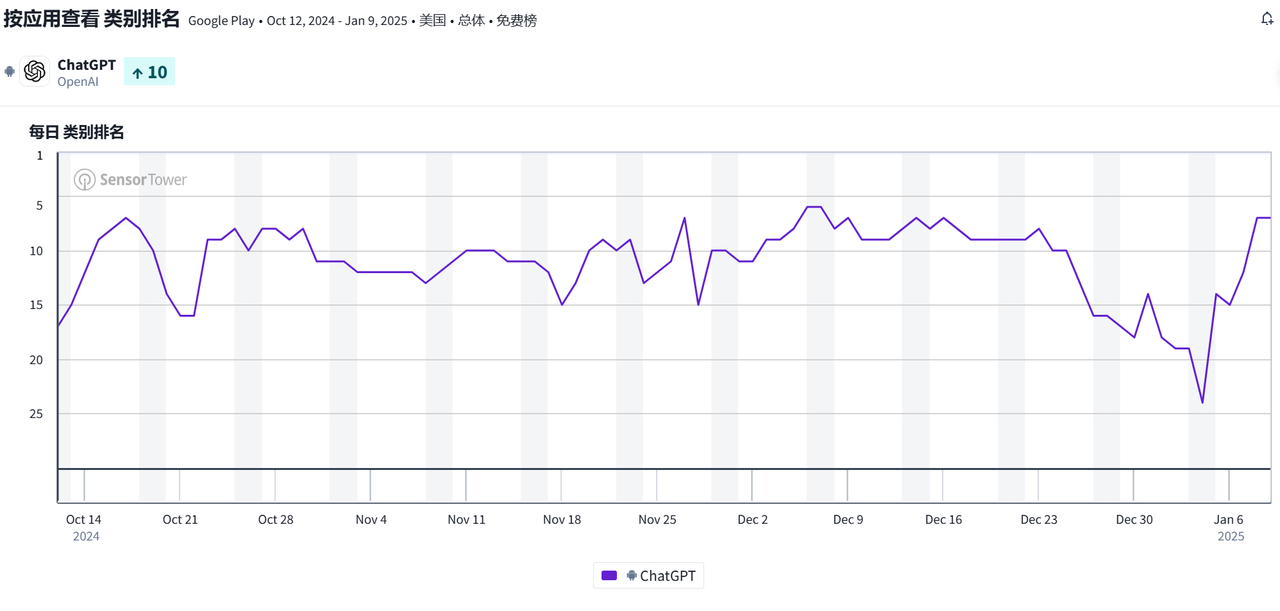
ChatGPT’s historical ranking in the North American Google Play free-app chart (source: Sensor Tower)
Sensor Tower data shows that ChatGPT ranked seventh in the North American Google Play overall free-app chart on January 9, 2025. During the previous 90 days it fluctuated between fifth and twenty-fifth place, maintaining strong visibility (Sensor Tower, n.d.).
3.3.3 In-app Purchases and Active Users
After the release of GPT-4o, the star AI application ChatGPT saw a 43% month-over-month revenue increase in May 2024. Revenue exceeded $45 million in August 2024, a historical high. Between January and August 2024, ChatGPT generated $230 million, accounting for 39% of revenue in the AI-and-chatbot category. By August 2024, cumulative revenue had exceeded $270 million (Sensor Tower, 2024).
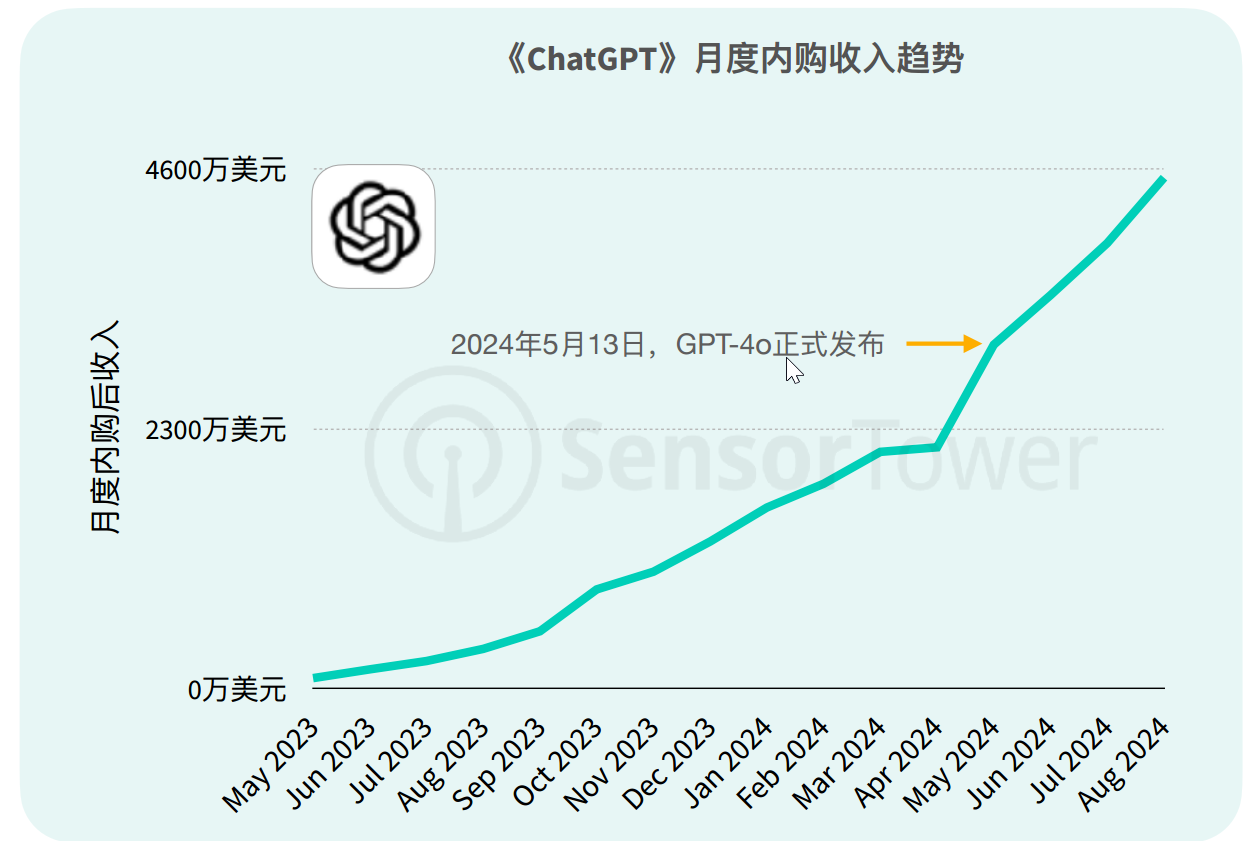
ChatGPT mobile revenue growth (source: Sensor Tower)
Monthly active users also grew steadily. In August 2024, ChatGPT surpassed 190 million monthly active users and became the world’s largest AI application by active-user scale (Sensor Tower, 2024).
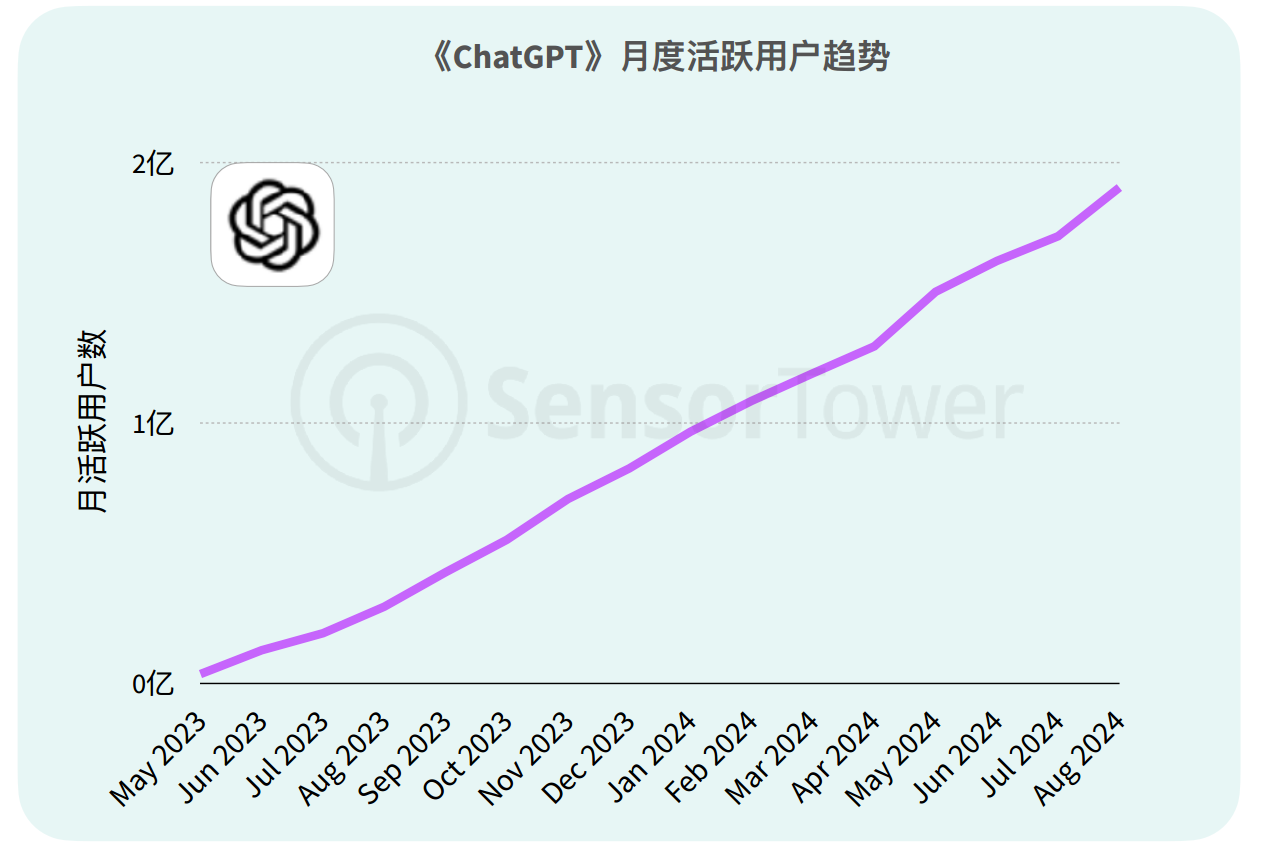
ChatGPT monthly active-user growth (source: Sensor Tower)
4. Product Analysis
4.1 Product Structure
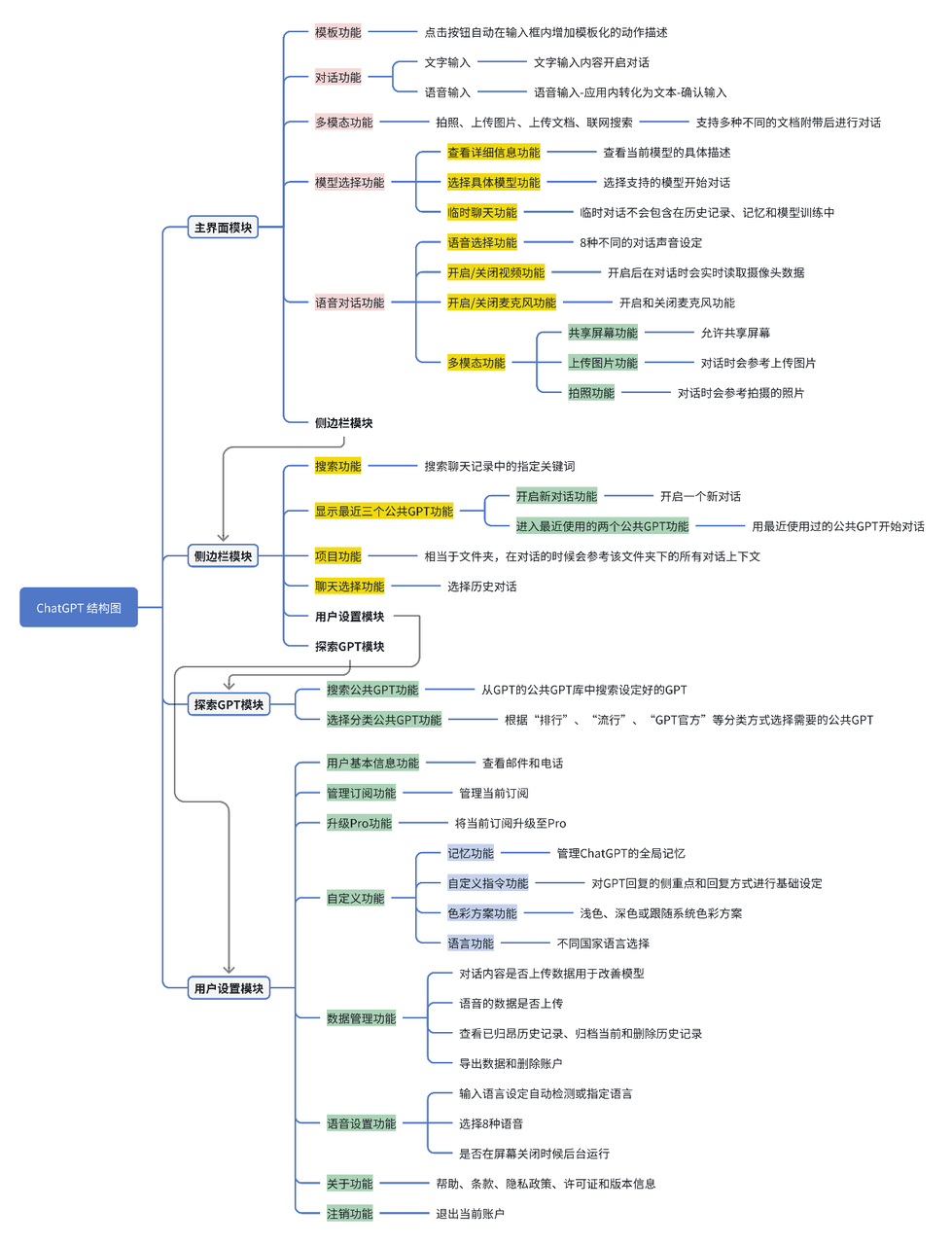
ChatGPT Android product structure
The structure is relatively simple. Core functions can be configured from the main interface, while the sidebar mainly contains the GPT store and conversation history. This design fits common mobile habits and allows users to get started quickly.
4.2 User Flow
The user flow is broadly similar to that of a search engine and is relatively simple because it mainly follows the core functions. It is omitted here.
4.3 Standard Operating Procedure for Evaluating an Individual LLM
Because evaluating an individual large language model involves a complex process, this section presents only the standard operating procedure.
Goal: Ensure that an LLM can meet user needs efficiently, accurately, and reliably in a specific application scenario, while supporting continuous optimization.
Step 1: Define the evaluation goal (Why)
1.1 Define the goal from the application scenario
The evaluation goal must be closely connected to the actual use case. For example:
- Text generation: Evaluate fluency, logical clarity, style fit, and information accuracy.
- Question answering: Evaluate accuracy, relevance, completeness, and understanding of user intent.
- Code generation: Evaluate correctness, executability, and efficiency.
- Information extraction: Evaluate accuracy, coverage, and lack of ambiguity.
Concrete examples include:
- E-commerce customer-service LLM: Answer customer questions quickly and accurately, solve after-sales issues, and improve satisfaction.
- Content-creation LLM: Generate high-quality articles, scripts, or advertising copy for a specific creative task.
1.2 Examples of more specific goals
For an LLM that generates high-quality articles, evaluation goals may include:
- Whether the article follows a requested style, such as news reporting or technology commentary.
- Whether the logic is clear and the structure is complete.
- Whether information is accurate and sources are reliable.
- Whether the article is engaging and readable.
For an LLM that assists with code generation:
- Can the generated code run?
- Does it follow best practices and coding standards?
- How efficient and performant is it?
Step 2: Design the evaluation strategy (What)
2.1 Build an evaluation framework
An evaluation framework should include multiple dimensions:
- Accuracy and precision: Does the output meet expectations and contain correct information?
- Recall and coverage: Does it include all relevant information or answers?
- Completeness: Is the answer comprehensive, or is important information missing?
- Relevance: Is the output related to the user’s prompt?
- Fluency and readability: Is the generated text natural and easy to understand?
- Logic and coherence: Is the reasoning clear and internally consistent?
- Satisfaction and user experience: How do users evaluate the output overall?
- Efficiency and performance: How quickly does the model respond and how many resources does it consume?
- Safety and ethics: Does the output contain harmful or inappropriate material?
- Explainability and traceability: Can the reason for an answer be explained and its information traced to a source?
Possible scoring methods include:
- Quantitative metrics: Accuracy, recall, F1, BLEU, and similar measures.
- Qualitative metrics: Human ratings, such as a 1–5 Likert scale for fluency and logic.
2.2 Examples
For an e-commerce customer-service LLM:
- Metrics: Answer accuracy, issue-resolution rate, customer satisfaction, and response time.
- Scoring: Satisfaction can be collected through an online questionnaire or a rating after an issue is resolved.
For a content-creation LLM:
- Metrics: Originality, information accuracy, readability, and fit with the target audience.
- Scoring: Human reviewers rate each dimension independently.
Step 3: Choose the evaluation method (Who/How)
3.1 Human evaluation
- Advantages: Better for subjective factors such as satisfaction and for detecting subtle errors or inappropriate wording.
- Disadvantages: Time-consuming, expensive, and vulnerable to subjective bias.
- Use cases: Content quality, creativity, logic, and complex judgment.
3.2 Automated evaluation
- Advantages: Efficient, inexpensive, reproducible, and less affected by subjective factors.
- Disadvantages: May not evaluate subjective factors or capture complex semantics well.
- Use cases: Rapid evaluation of large datasets or objective metrics such as accuracy.
3.3 Hybrid evaluation
Automation performs initial screening and performance monitoring, while human reviewers perform deeper analysis and quality control. This combines the strengths of both approaches and produces a more complete evaluation.
Step 4: Build the evaluation set (Data)
4.1 Data sources
- Real data: Use data generated by real users whenever possible so that the evaluation reflects actual performance.
- Constructed datasets: If real data is insufficient, build synthetic data covering varied situations and edge cases.
- Synthetic data should be as close to real data as possible and cover many corner cases.
- Data augmentation and human annotation can be used to create a diverse set.
4.2 Dataset size
The dataset should cover the evaluation dimensions and be large enough to measure performance effectively. Its size should be chosen according to the evaluation goal.
4.3 Examples
- E-commerce customer-service LLM: Use historical customer questions and simulate common support scenarios.
- Content-creation LLM: Build text samples covering different topics and styles, including different copywriting requirements.
Step 5: Execute the evaluation process (Process)
5.1 Evaluation stages
- Initial evaluation: Quickly test basic functions and eliminate obvious errors.
- Detailed evaluation: Test each dimension in depth and record the data.
- Cross-validation: Have multiple teams or reviewers evaluate independently to reduce bias.
5.2 Evaluation team
A professional evaluation team may include:
- Prompt engineers: Optimize prompts and improve model performance.
- Evaluators: Run evaluations, record data, and analyze results.
- Technical staff: Maintain evaluation tools and provide technical support.
5.3 Communication and collaboration
Team members should communicate sufficiently, clarify responsibilities, and resolve issues promptly.
Step 6: Summarize the evaluation results (Analysis)
6.1 Data analysis
Analyze evaluation data, identify model strengths and weaknesses, and visualize the findings in charts.
6.2 Review
- Model level: Analyze accuracy, recall, F1, and other indicators; identify bottlenecks; adjust model parameters; improve training data; and optimize prompts.
- Business level: Analyze production performance such as user feedback, traffic, and conversion, then measure how users accept prompts and iterate accordingly.
6.3 Report writing
Write an evaluation report that summarizes the process and results and proposes recommendations.
(Xiaohongshu, 2024; Zhihu, 2024)
4.4 Product Iteration Roadmap
A review of the official release notes shows that updates have mainly focused on model capability, multimodality, functional and tool expansion, user-experience optimization, monetization and team collaboration, and the distinction between free and paid users.
Android-specific updates included the app launch on July 25, 2023; voice features on September 25, 2023; image input on September 25, 2023; experience improvements on November 22, 2024; and video and screen sharing during voice chats on December 12, 2024.
From a product-function perspective, future improvements could include prompt management, offline functionality, and better sharing features (OpenAI, 2024).
4.5 Summary
The product’s strengths include creativity and inspiration, efficient information retrieval, versatile scenarios, and strong text generation. These capabilities save users considerable time, and most users report a good overall experience.
The product also faces significant pain points. The most visible are connection and login problems and insufficient answer quality and accuracy, including inaccurate information, hallucinations, and weak intent understanding. Other issues include unstable or incomplete features, such as broken read-aloud functions and limits on image uploads. Users also mention paid-feature restrictions, source bias, uneven code quality, and data-security and privacy concerns. They expect more stable service, more personalized interaction, and more professional support in specific domains.
5. User Feedback
5.1 Data Source
On January 4, 2025, I used a Google Play interface and the Node.js google-play-scraper library to crawl 3,000 reviews in reverse chronological order. From these, 619 reviews longer than 15 Chinese characters were selected and sent one by one to Google’s Gemini 2.0 Flash Experimental model to identify weaknesses. The resulting statistics were used as a reference for Android product optimization.
5.2 Summary of Negative User Feedback
Using full-count analysis, the 619 reviews mentioned 507 weaknesses. They can be grouped into the following categories:
Connection and login problems
Users reported white screens, loading loops, failure to load, network errors, SSL-certificate errors, device-time errors, and VPN detection while logging in or connecting to the server.
Examples:
- “It stays on a white loading screen and never reaches the login page.”
- “The login says the time is wrong, or keeps asking me to log in without entering the conversation screen.”
- “There is a network configuration problem; it seems the server responded with an incorrect SSL certificate.”
Functional defects and instability
This includes missing or broken functions and unstable performance, such as read-aloud, voice, image and file uploads, memory, and editing.
Examples:
- “Read-aloud does not work, and the available voices sound stiff and cannot express tone.”
- “Videos used to be accessible, but now they are not.”
- “After the update, conversations containing images quickly hit a limit and cannot continue.”
Answer quality and accuracy
Users reported incorrect, inaccurate, irrelevant, or poorly targeted answers, including insufficient understanding of user intent.
Examples:
- “It does not really understand what I ask. It keeps loading and then gives an answer that is completely wrong.”
- “There are many errors. It was wrong four times in a row and eventually returned to the original wrong answer.”
- “After upgrading to the o model, it often rambles and sometimes performs at the level of 3.5.”
Information sources and bias
Users mentioned biased or insufficient sources, outdated information, over-reliance on Chinese platforms, and limited access to local information.
Examples:
- “When I ask it to search, it only searches Zhihu, Sina, Sohu, Douban, and other Chinese platforms.”
- “There is not enough data to answer questions about prices on Xianyu accurately.”
- “I am abroad and use Chinese to ask about local information, but GPT keeps finding material from China.”
Usage limits and payment issues
Users mentioned restrictions on free features, inconvenient payment, and limitations that remain after subscribing.
Examples:
- “It is November 5, 2024, and I cannot take it anymore. I use 4o, but most answers are wrong.”
- “GPT-4o has a free quota, and after using it up I have to wait two hours.”
- “File uploads are also limited, and after reaching the limit I have to wait two hours.”
Other issues
This includes scattered issues such as moderation, data privacy, voice quality, user experience, and comparisons with domestic AI products.
5.2.1 Google Play Weakness Statistics
| Weakness (full count) | Count | Share |
|---|---|---|
| Functional defects and instability | 110 | 21.70% |
| Answer quality and accuracy | 116 | 22.88% |
| Connection and login problems | 185 | 36.49% |
| Other issues | 23 | 4.54% |
| Usage limits and payment issues | 63 | 12.43% |
| Information sources and bias | 10 | 1.97% |
| Total | 507 | 100.00% |
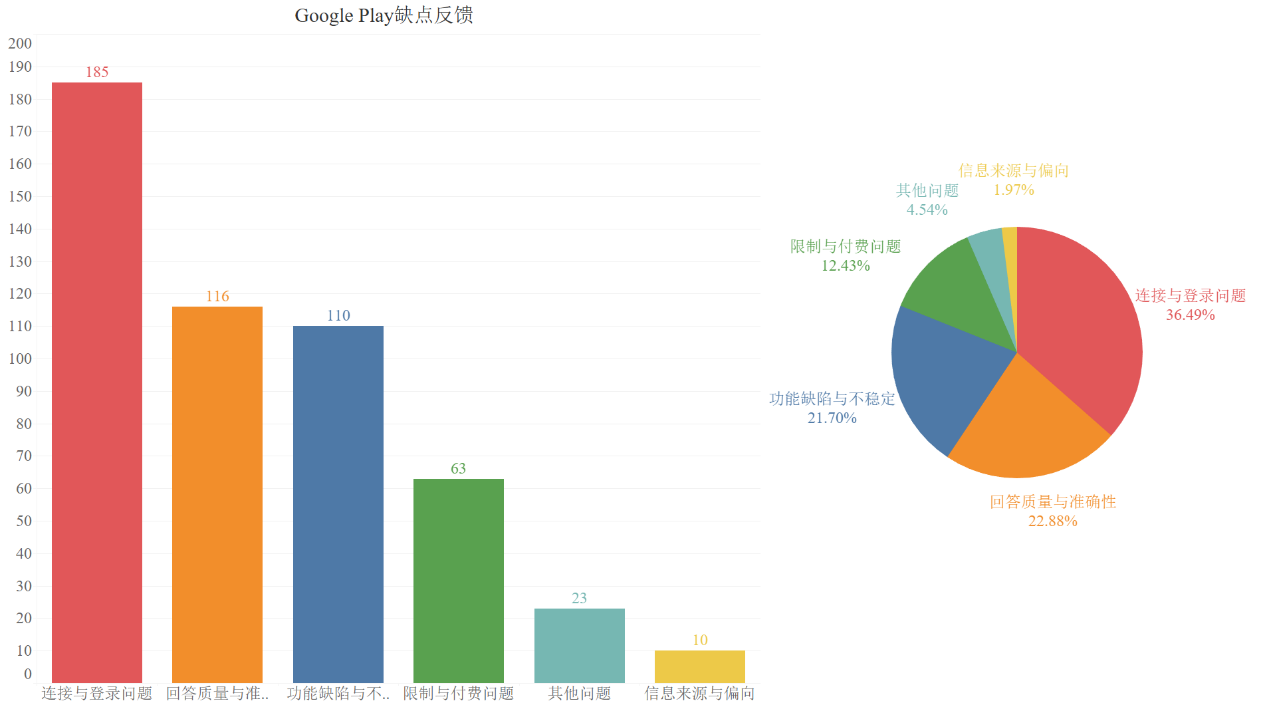
Classification of negative feedback from Google Play Android users
Network connection is the largest problem (36.49%). In the Chinese context, this is difficult to solve through product changes and can be interpreted as a structural advantage for domestic products.
Answer quality and accuracy are the second-largest category (22.88%). They require improvement to the base model and prompts. The product could provide lower-barrier prompt guidance and offer more specialized options in vertical domains.
Functional defects and instability (21.70%) deserve particular attention from product managers. Individual issues should be reviewed and addressed through targeted optimization.
Usage limits and payment issues account for 12.43%. The detailed comments suggest that Chinese users’ payment habits may differ from those in other regions, so the product could simplify paid flows and optimize the distinction between free and paid users.
Information-source bias (1.97%) and other issues (4.54%) also deserve appropriate attention to improve the overall experience.
6. Competitor Analysis
Google Gemini and Doubao were selected as representatives of international and Chinese markets.
6.1 Competitive Landscape
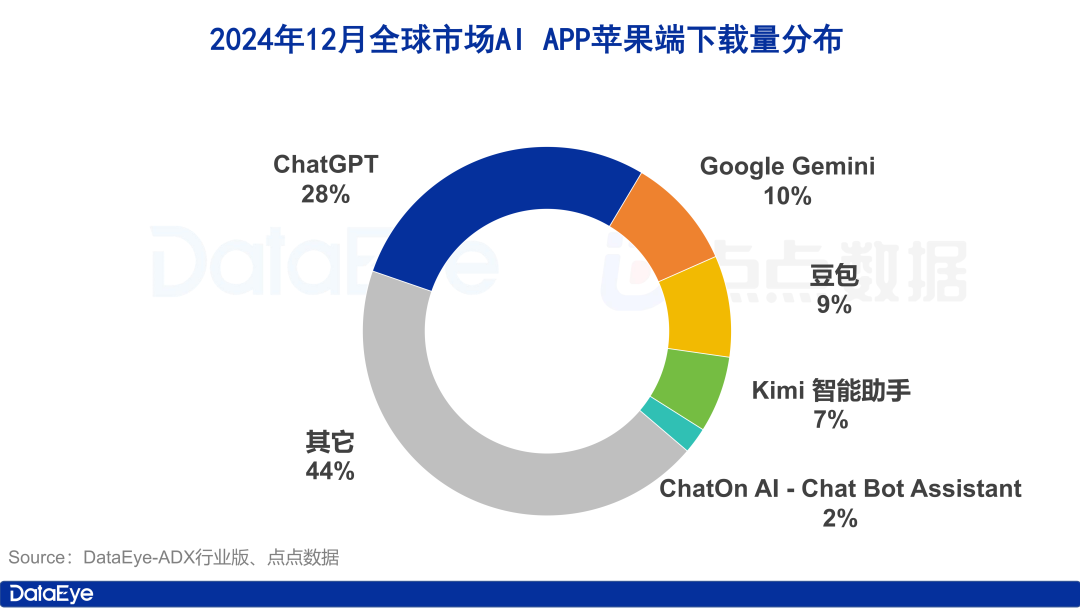
Top five AI-app downloads worldwide in December 2024, including mainland China (source: Diandian Data)
According to Diandian Data, AI applications in the global iOS market, including mainland China, recorded an estimated 69.752 million downloads in December 2024. ChatGPT, Google Gemini, Doubao, Kimi, and ChatOn AI ranked in the top five and together represented 56% of global iOS AI-app downloads.
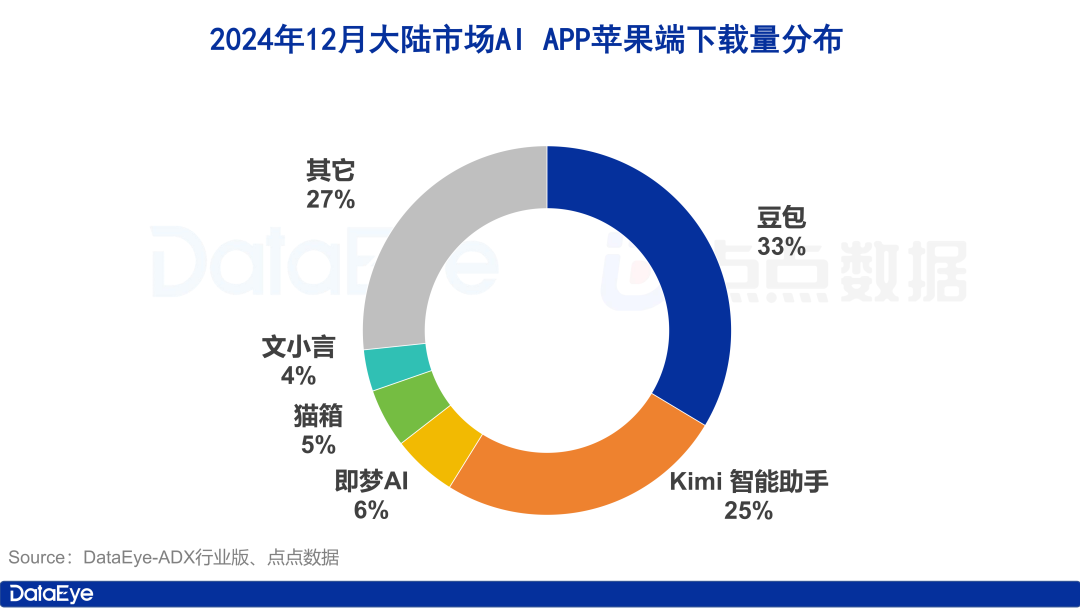
Distribution of AI-app downloads in the mainland China iOS market in December 2024 (source: Diandian Data)
In mainland China, estimated iOS AI-app downloads reached 18.180 million in December 2024. Doubao and Kimi led the market, with download shares of 33% and 25%, respectively, forming the first tier (The Paper, 2024).
These data suggest that ChatGPT and Gemini lead the international general-chatbot market, while Doubao has a clear lead in mainland China.
6.2 Differentiation from Competitors
| Feature | ChatGPT | Gemini | Doubao |
|---|---|---|---|
| Developer | OpenAI | ByteDance | |
| AI models | GPT-4o mini (free); GPT-4, GPT-4o, o1-preview, and o1 mini (paid) | Gemini 1.5 Flash (free); Gemini 1.5 Pro (paid) | Doubao general-purpose pro, Doubao general-purpose lite, and others |
| Context window | 128,000 tokens | Up to 1,000,000 tokens | 128,000 tokens |
| Supported languages | More than 50 | More than 40 | 6 |
| Platforms | Web, mobile, desktop | Web and mobile | Web, iOS, Android, Windows, macOS |
| Price | Free; ChatGPT Plus at $20/month | Free; Gemini Advanced at $19.99/month, with the first two months free | Free; commercial pricing at RMB 0.0008 per 1,000 tokens |
| Image generation | DALL·E 3, with limits on free accounts | Imagen 3, with no image-generation quantity limit stated in the source | Image understanding and video generation |
| Memory | Enabled by default to record preferences and customize responses | Web subscribers only, similar to ChatGPT custom instructions | Not supported |
| File conversion | Converts files between formats, such as an article into a presentation | Not supported | Supports multiple document-parsing and processing functions |
| Data management | Archived conversations | Archived conversations | Archived conversations |
| Web search | Microsoft Bing | Google Search | Searches and integrates public internet information |
| Ecosystem integration | Integrates with services such as Google Drive, with manual file selection | Deep integration with Gmail, Drive, Maps, and other Google services | Deep integration with ByteDance products such as Douyin and Feishu |
| Custom chatbots | Custom GPTs with knowledge files, image generation, and code execution | Gemini Gems with more limited customization and no image generation or voice-mode interaction | Personalized agents, with more than eight million reportedly created |
| Conversation sharing | Supports sharing, but not conversations containing AI-generated images | Supports sharing, including AI-generated images | Supported |
| Target users | Broad audience with flexible integration options | Users deeply invested in the Google ecosystem | ByteDance ecosystem users, especially in China |
(Zapier, 2025)
The main differences can be summarized as follows:
- ChatGPT: More professional and international, with strengths in logical reasoning and code generation.
- Gemini: Deeply serves Google users and gains convenience from its ecosystem.
- Doubao: Localized optimization, accessible pricing, and stronger Chinese-language suitability for Chinese users.
6.3 ChatGPT’s Differentiated Advantages
ChatGPT’s advantages are concentrated in four areas:
- Logical reasoning and coding: Strong reasoning and code-generation and execution capabilities.
- Customization and tooling: Highly customizable chatbots and web-based demonstration capabilities.
- Platforms and integrations: Cross-platform compatibility and a broad range of third-party integrations.
- Image generation and creative support: A mature DALL·E 3 image-generation tool.
7. Conclusion
7.1 SWOT Analysis
Strengths
- Strong content generation: Based on advanced models such as GPT-4o, ChatGPT performs well in text generation, code generation, and content creation, producing high-quality and diverse content.
- Cross-platform continuity: Web, mobile, and desktop support allow users to switch devices while keeping a consistent experience, which helps build retention.
- Multimodal input: Android supports voice, image, video, and document input, enabling flexible interaction in mobile contexts.
- Strong reasoning and coding: Its reasoning, code generation, and code-execution capabilities are valuable to professional users.
- Customization and tooling: Custom chatbots and demonstration-building functions meet personalized needs.
Weaknesses
- Mobile limitations: Compared with the web version, some multimodal features are less stable, and advanced features such as custom instructions may not be fully synchronized.
- Network connectivity: In mainland China, connection failures, slow login, and repeated errors can significantly affect the experience.
- Information accuracy and hallucinations: Incorrect or invented information reduces user trust.
- Interaction details: Editing glitches, the inability to copy and paste code, and message limits reduce efficiency.
- Information bias: Search results can favor domestic platforms, while current and local information may be insufficient.
- Payment limits and acceptance: Free functions are restricted, and some features such as the 4o model still have usage limits after payment.
Opportunities
- Rapid growth of mobile AIGC: As more people adopt AI tools on mobile devices, ChatGPT Android has substantial market potential.
- Fragmented scenarios: Users increasingly need efficient mobile help for content generation, learning, and office productivity.
- Personalization and contextualization: Tailoring the product to user groups and scenarios can improve retention.
- Rise of AI agents: Agents represent a new direction for AI applications and could help ChatGPT complete tasks proactively.
Threats
- Fast-moving competitors: Gemini, Doubao, and other products are iterating quickly, especially on mobile.
- Low user loyalty: Homogenization makes it easy for users to switch between similar AI products.
- Data-security and privacy risks: Growing concern about safety and privacy may cause churn if the product does not respond adequately.
- Eroding technical barriers: More large models may eventually catch up with ChatGPT’s technical advantages.
7.2 Product Optimization Recommendations
- Performance optimization: Reduce startup and page-load time, optimize inference speed, and improve overall mobile smoothness.
- Functional enhancement:
- Develop mobile-specific features such as more convenient voice interaction and gesture controls.
- Improve the accuracy and processing speed of voice, image, and video input.
- Strengthen vertical-domain capabilities in programming, content creation, and knowledge search.
- Content accuracy: Improve training-data quality and model tuning to reduce hallucinations and incorrect output.
- Functional details: Improve editing, copy-and-paste, and data-saving functions to remove operational friction.
- Information sources: Reduce dependence on any single platform and support more localized information.
- User experience:
- Simplify the interface, reduce steps, and improve operating efficiency.
- Offer more personalization settings.
- Provide clearer prompt guidance so users can obtain more accurate output.
- Payment system: Offer more flexible plans and make the choice between free and paid features easier.
7.3 Future Development Strategy
- User education and promotion:
- Educate Android users through tutorials and videos, especially about mobile scenarios.
- Expand awareness and coverage through social media and app stores.
- Technical innovation:
- Expand AI-agent capabilities to automate more tasks.
- Continue model iteration to improve generation quality, knowledge coverage, and reasoning.
- Commercial exploration:
- Explore advertising while protecting user experience.
- Consider more affordable subscriptions to lower the payment barrier.
- Offer differentiated plans for different user groups.
- Ecosystem development: Deeply integrate with other applications and services to build a more complete ecosystem.
References
Bhaimiya, S. (2023, February 2). ChatGPT may be the fastest-growing consumer app in internet history, reaching 100 million users in just over 2 months, UBS report says. Business Insider. Retrieved from https://www.businessinsider.com/chatgpt-may-be-fastest-growing-app-in-history-ubs-study-2023-2
Reddit. (2023a, April 19). What do you actually use ChatGPT for? [Online forum discussion]. Reddit. Retrieved from https://www.reddit.com/r/ChatGPT/comments/12stfb9/what_do_you_actually_use_chatgpt_for/
Reddit. (2023b, May 3). What do you all actually use ChatGPT for? [Online forum discussion]. Reddit. Retrieved from https://www.reddit.com/r/ChatGPT/comments/133mc2v/what_do_you_all_actually_use_chatgpt_for/
Reddit. (2024, June 15). What do you use ChatGPT for in your daily life? [Online forum discussion]. Reddit. Retrieved from https://www.reddit.com/r/ChatGPTPromptGenius/comments/1fcklhp/what_do_you_use_chatgpt_for_in_your_daily_life/
Tencent News. (2025, January 7). ChatGPT Pro subscription is currently running at a loss. Retrieved from https://news.qq.com/rain/a/20250107A0106N00?utm_source=chatgpt.com
ESM China. (n.d.). OpenAI explores B2B monetization strategies for ChatGPT. Retrieved January 9, 2025, from https://www.esmchina.com/trends/43605.html?utm_source=chatgpt.com
The Times. (n.d.). OpenAI considers advertising for ChatGPT. Retrieved January 9, 2025, from https://www.thetimes.com/business-money/technology/article/openai-considers-advertising-for-chatgpt-cqhdcj85f?utm_source=chatgpt.com®ion=global
The Wall Street Journal. (n.d.). OpenAI, Bain expand AI partnership to sell ChatGPT to businesses. Retrieved January 9, 2025, from https://www.wsj.com/articles/openai-bain-expand-ai-partnership-to-sell-chatgpt-to-businesses-d17775dc?utm_source=chatgpt.com
Statista. (n.d.). Number of monthly ChatGPT and Gemini mobile app downloads worldwide from May 2023 to September 2024. Retrieved January 9, 2025, from https://www.statista.com/statistics/1497377/global-chatgpt-vs-gemini-app-downloads/#statisticContainer
Sensor Tower. (n.d.). Category rankings and app analysis for ChatGPT (October 12, 2024–January 9, 2025). Retrieved January 9, 2025, from https://app.sensortower.com/app-analysis/category-rankings?os=android&start_date=2024-10-12&end_date=2025-01-09&uai=64665f59b3ae2712001279ed&saa=com.openai.chatgpt
Sensor Tower. (2024, January). 2024 AI app market insight: Revenue increased 51% year over year in January–August, exceeding $2 billion, with full-year revenue expected to reach $3.3 billion. Sensor Tower. Retrieved from https://sensortower.com/zh-CN/blog/state-of-ai-apps-2024-report-CN
Xiaohongshu. (2024). Strategy guide: How to evaluate a large language model. Xiaohongshu. Retrieved from https://www.xiaohongshu.com/explore/66f67165000000001b020b6d?xsec_token=ABX5jB7KY821V26oUNvAaIFT6T4nXH57isPoDz1sMt1JI=&xsec_source=pc_search&source=web_explore_feed
Zhihu. (2024). LLM evaluation: How should a large language model be evaluated? Zhihu. Retrieved from https://zhuanlan.zhihu.com/p/644373658
OpenAI. (2024). ChatGPT — Release Notes. OpenAI. Retrieved from https://help.openai.com/en/articles/6825453-chatgpt-release-notes
The Paper. (2024). December AI monthly report: 69.75 million global iOS downloads, Google’s Gemini rises, and Xingye’s ad buying surges past Doubao. The Paper. Retrieved from https://m.thepaper.cn/newsDetail_forward_29852815
Zapier. (2025). Gemini vs. ChatGPT: What’s the difference? Zapier. Retrieved from https://zapier.com/blog/gemini-vs-chatgpt/